Solid-state battery work is stuck on factory problems: dendrites, sintering, quality control

Recent research and factory programs focus on the barriers between solid-state battery cells and mass production: dendrites, grain boundaries, sintering, cutting, and inline quality control. None of that yet proves low-cost automotive manufacturing.

01

web · Fraunhofer ILT

Laser processes as enablers for industrial solid-state batteries

Research-institute overview of laser cutting, structuring, drying, and sintering methods intended to move solid-state cells toward production.

webSource preview · opens the originalOpen original →

What changed

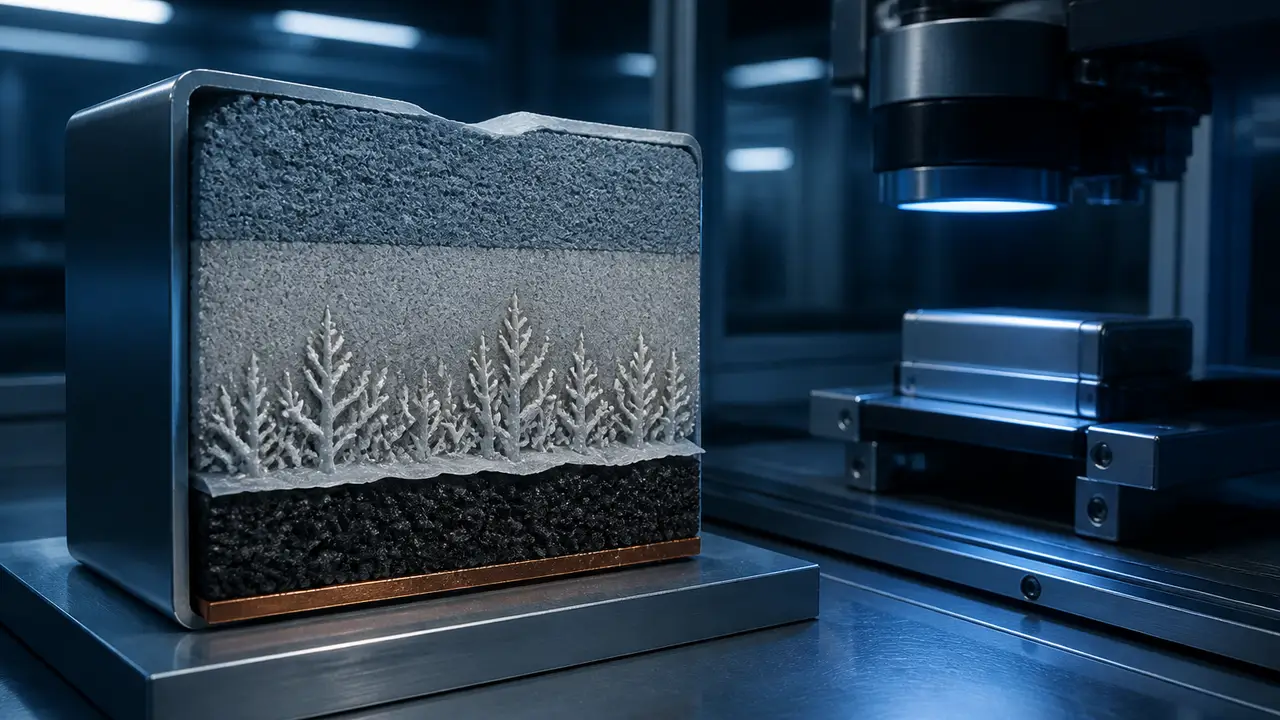
The solid-state story is moving from chemistry claims toward process control. Fraunhofer teams are developing laser methods to cut brittle layers, create useful microstructures, dry materials, and sinter ceramic electrolytes faster and more precisely. At the same time, new studies identify how mechanical stress, charged grain boundaries, and processing choices can let lithium penetrate a hard electrolyte or cause short circuits. These results give engineers specific defects to measure and manufacturing steps to redesign rather than treating failure as a vague materials problem.

02

web · Nature

Mechanically driven lithium dendrite penetration in garnet electrolyte

Peer-reviewed study explaining how soft lithium can penetrate hard ceramic electrolytes and what the mechanism implies for cell design.

webSource preview · opens the originalOpen original →

What remains unproved

A better laser step or clearer dendrite mechanism does not establish an automotive battery with competitive cost, yield, life, charging speed, and cold-weather performance. Ceramic layers can crack, interfaces can degrade, and pilot equipment may not transfer cleanly to high-volume lines. Published plans for future pilot production are not shipped vehicles. Comparisons also vary by cell size, pressure, temperature, and test protocol, making headline energy-density or cycle-life claims hard to compare across research groups and companies.
03

web · Nature Nanotechnology

Nanoengineered doping overcomes solid-state battery limits

Peer-reviewed work on doped garnet electrolytes designed to improve sintering behavior and grain-boundary performance.

webSource preview · opens the originalOpen original →

What to watch

Look for large-format cells made on pilot equipment with reported yield, scrap, cycle life, pressure, fast charging, and safety tests. Independent replication across batches matters more than a best-performing sample. Track whether laser steps reduce total energy and time or merely move cost elsewhere in the line. The decisive evidence will be a manufacturer publishing stable process windows and then delivering cells in vehicles or stationary systems at a price and warranty that compete with improved liquid-electrolyte batteries.

04

web · Nature Nanotechnology

Charged grain boundaries limit short-circuit endurance

Study connecting grain-boundary electrical behavior with short-circuit endurance in garnet solid-state electrolytes.

webSource preview · opens the originalOpen original →
View this collection on HRVSTR →