Ceiling height
Ten feet is the shop's rule of thumb, but Sean says the real test is whether you can swing a driver without changing your swing. He is 6-foot-4 and says he can't swing a driver under a 9-foot ceiling. He also tells buyers to look for beams, soffits and garage door tracks. In the garage in the video, the door track sits about 8 feet 3 inches up, which he says would block his left-handed follow-through but works for the right-handed owner.
A ceiling can also be too high. Ceiling-mounted launch monitors and projectors want to sit about 9 to 10 feet off the floor, so a 12-foot garage means dropping them 3 to 4 feet, and a 25- or 30-foot warehouse gets much harder.
Width
Twelve feet is the minimum the shop recommends. If you want to hit from the center of the screen, which Sean calls the most immersive setup and close to required for overhead and some radar units, he wants about 14 feet. A bay used only by right-handers or only by left-handers can shift that extra room to one side.
Depth
Depth mostly depends on the launch monitor. Side-view photometric and overhead units need little beyond swing room. Most radar units need about 8 feet behind the ball and 8 feet in front, plus a foot to 18 inches between the screen and the wall so a ball doesn't strike concrete. That is where the 17-to-18-foot figure comes from. A short-throw projector on the floor sits about 6 feet from the screen, while a standard-throw 4K projector mounted far back can cast your shadow on the screen.
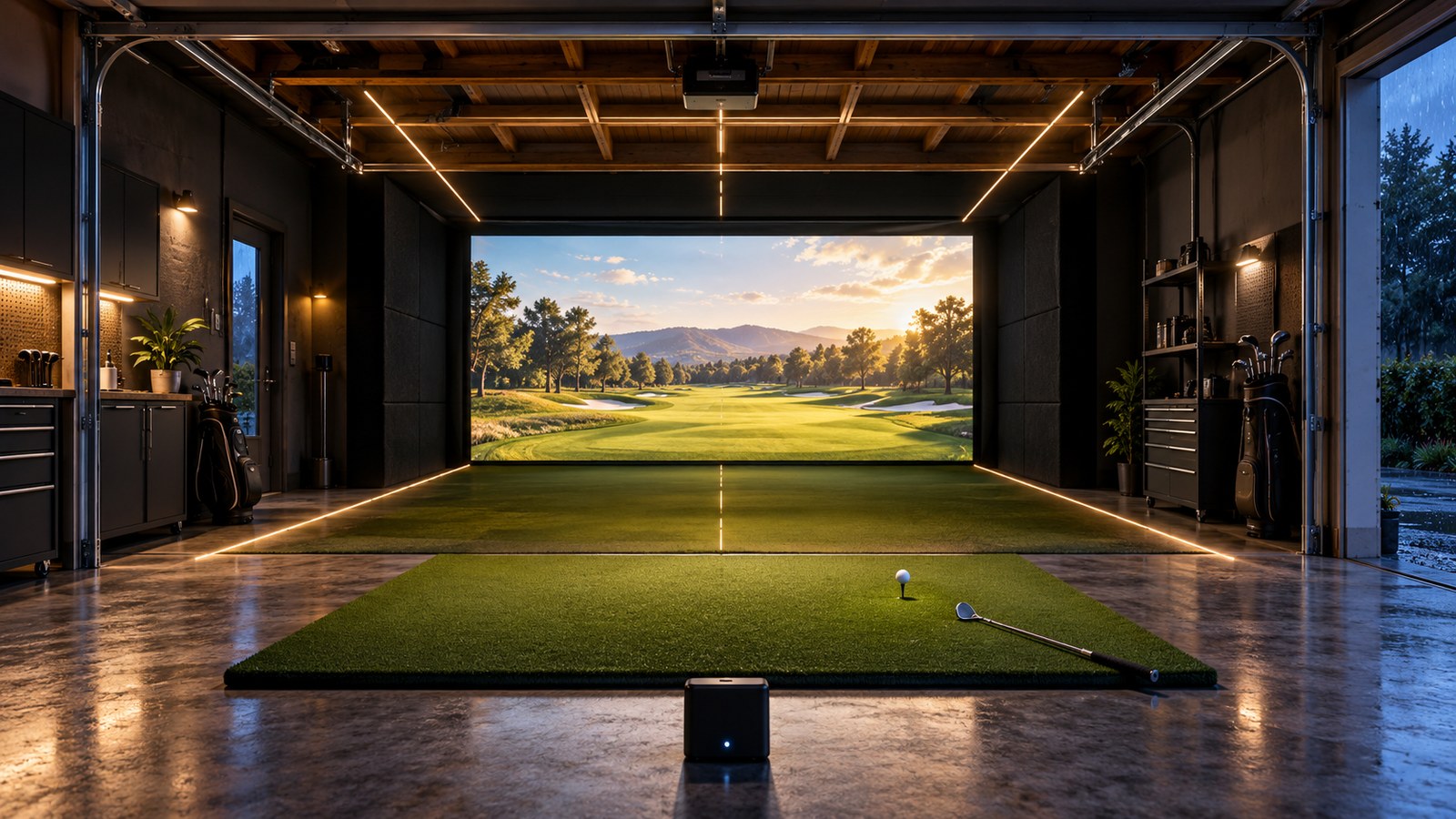
In the featured garage, the hitting spot is about 11 feet from the screen, the 8-foot enclosure fits under the door rails, and the turf slides so a car can still park.
Before you buy anything, tape out all three dimensions with a driver in hand, then pick your launch monitor before you settle on a room.
 webSource preview · opens the original↗Open original →