Researchers are connecting lab-grown neurons to computers

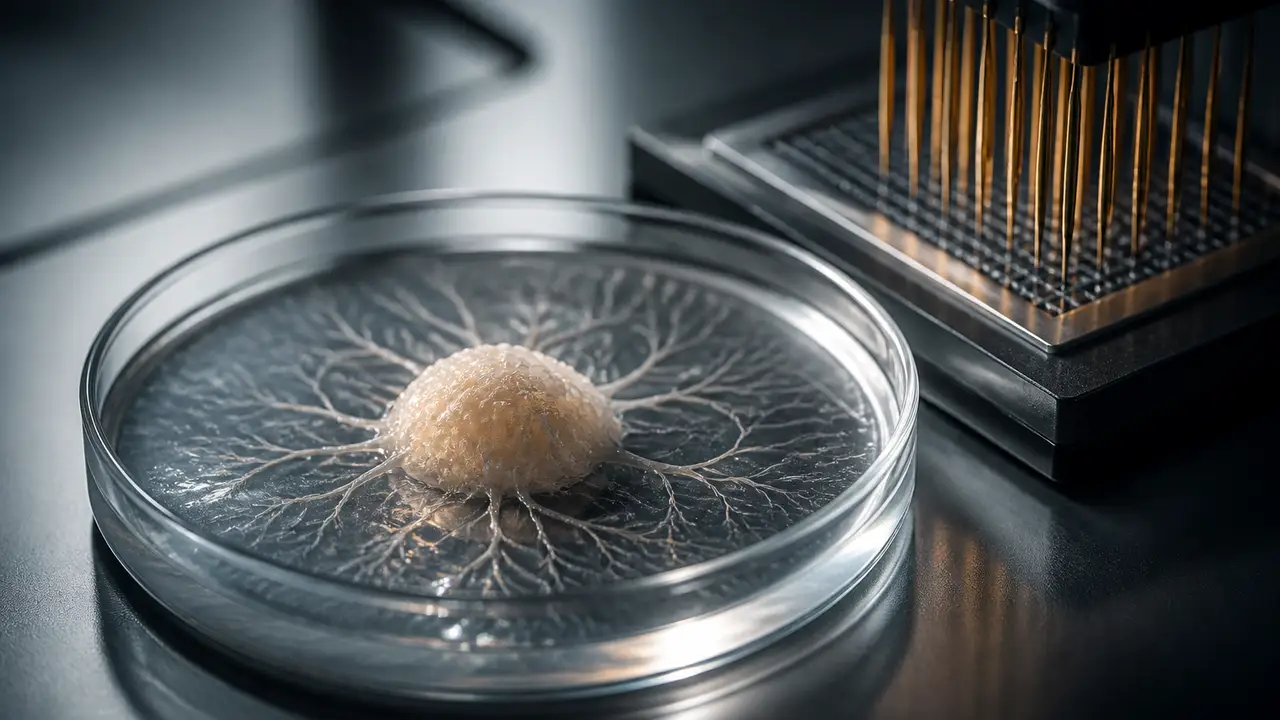
Researchers are connecting lab-grown neural tissue to electrode arrays and studying whether living networks can process information. The work also forces early decisions about donor consent and moral limits.
01

web · Nature Portfolio

Biocomputing and Synthetic Intelligence

Current research collection spanning organoid computing, biohybrid systems, synthetic intelligence, interfaces, and governance questions.

webSource preview · opens the originalOpen original →

What changed

Scientists can grow three-dimensional neural tissue, stimulate it through electrode arrays, record its activity, and use changes in that activity as computational output. Prior experiments have demonstrated simple pattern and prediction tasks, while a wider research community is building common methods across neuroscience, tissue engineering, electronics, and machine learning. The field now has dedicated funding and a growing body of reviews. Its credible present is a controllable biological research system, not a conscious desktop computer or a general-purpose AI.

02

web · Nature

Researchers are building computers that run on brain organoids

Expert argument that donor consent for brain-tissue biocomputing needs more specific treatment as computational uses expand.

webSource preview · opens the originalOpen original →

What remains unproved

Current organoids are small, variable, difficult to maintain, and far from the structure or capability of a human brain. Researchers have not shown that living systems outperform silicon on useful workloads once culture, interfaces, energy, equipment, and labor are counted. Claims about learning can rest on narrow definitions and tiny tasks. Moral status is uncertain, but uncertainty does not justify sensational claims of awareness. Donors may also have agreed to medical research without anticipating that their cells would become part of a computing experiment.

03

web · U.S. National Science Foundation

Biocomputing through Engineering Organoid Intelligence

Federal research program defining engineered biological information processing, inputs, outputs, actuation, and interdisciplinary goals.

webSource preview · opens the originalOpen original →

What to watch

Watch for repeatable benchmarks across laboratories, stable cultures over long periods, clear comparisons with silicon and neuromorphic chips, and evidence that a biological system adds scientific value. Governance should specify cell provenance, donor permission, allowed uses, monitoring, and stopping rules before capability rises. Researchers also need shared language that distinguishes adaptation, information processing, sentience, and consciousness. The best near-term projects may use the systems to study learning or neurological disease rather than claim a new class of commercial computer.

04

web · arXiv

Brain Organoid Computing: an Overview

Technical overview of brain-organoid computing methods, characteristics, interfaces, potential uses, and open challenges.

webSource preview · opens the originalOpen original →
View this collection on HRVSTR →